

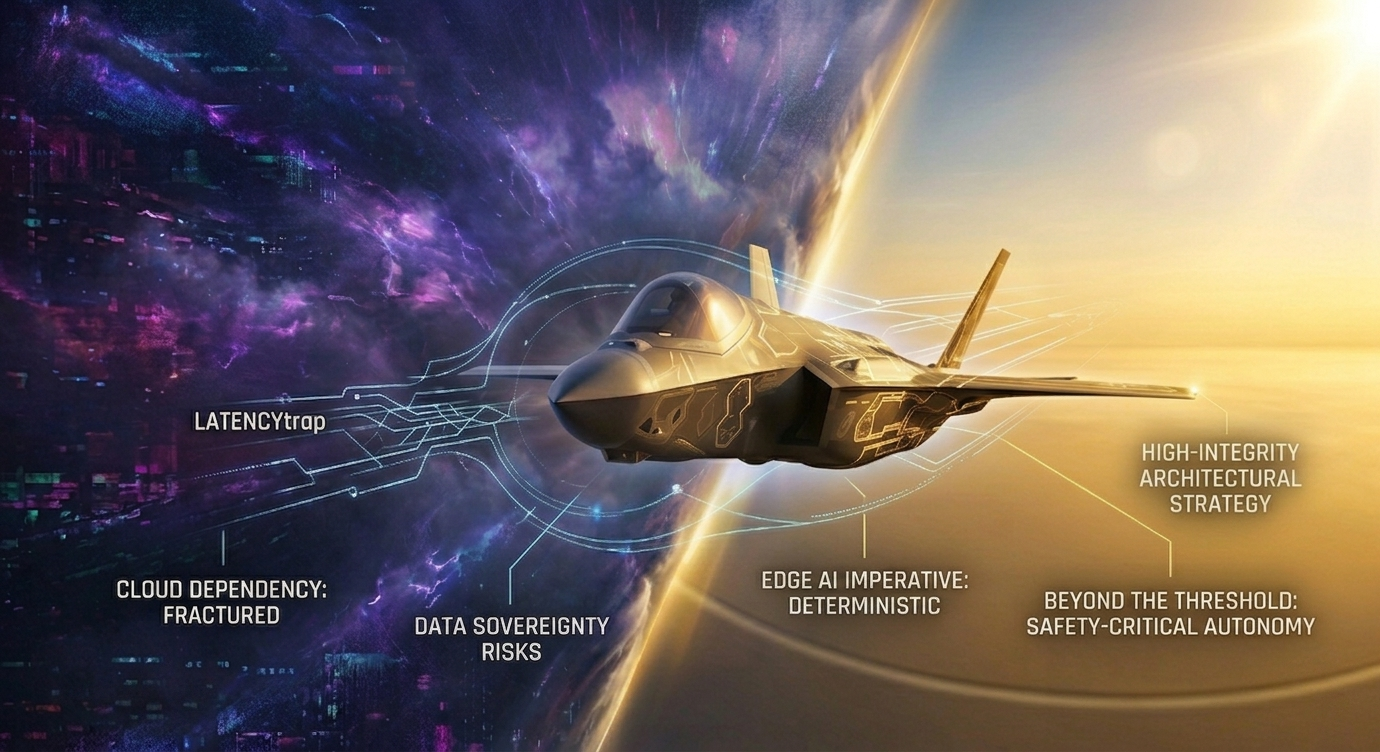
The Latency Trap: When Cloud Dependency Meets Flight Physics
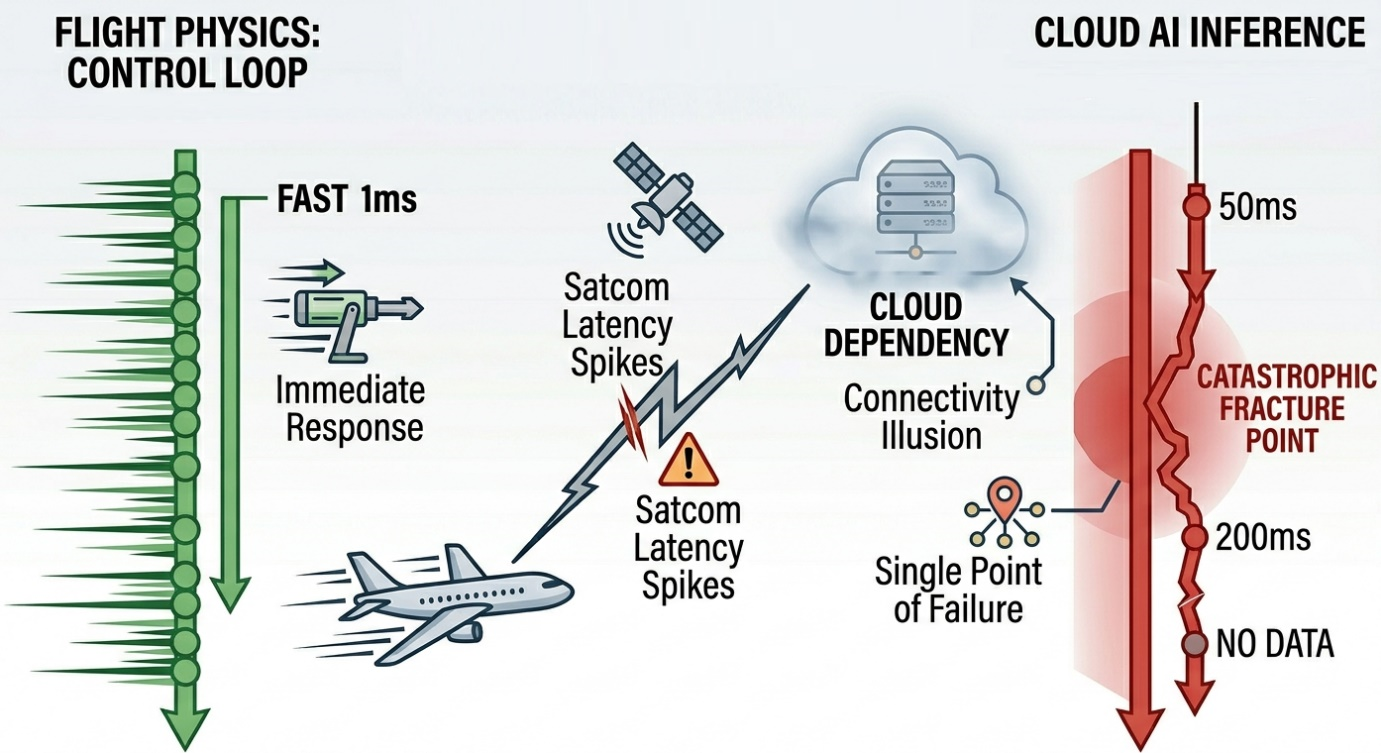
Modern AI achieves extraordinary feats on vast cloud servers. Cloud-based solutions excel in fleet management and route optimization. Yet, a critical and dangerous fracture emerges the moment we turn to the act of flying itself. For an AI decision loop within a flight control system, even a single millisecond of latency can prove catastrophic. This is the "connectivity illusion," and it creates a threefold safety crisis:
- Non-Deterministic Latency: Satellite links exhibit unpredictable, fluctuating delays. The notion of a collision avoidance system querying a distant server is fundamentally incompatible with flight safety.
- Data Sovereignty: The continuous transmission of flight data off-board creates an unacceptable strategic risk, exposing sensitive operational information.
- Denied Environments: In scenarios of electronic warfare (jamming), solar storms, or remote oceanic crossings, connectivity is not guaranteed. In these moments, a cloud-dependent AI becomes entirely inoperative, creating a single point of failure.
The Adversarial Environment and the Certification Conundrum
This challenge is amplified by a core structural conflict: the inherent black-box nature of Neural Networks versus the rigid determinism demanded by the DO-178C standard [1]. Training a safety-critical Edge AI model requires massive datasets covering rare and hazardous events that are often impossible to replicate in real-world tests. More critically, aviation standards mandate that software functions be deterministic and traceable.
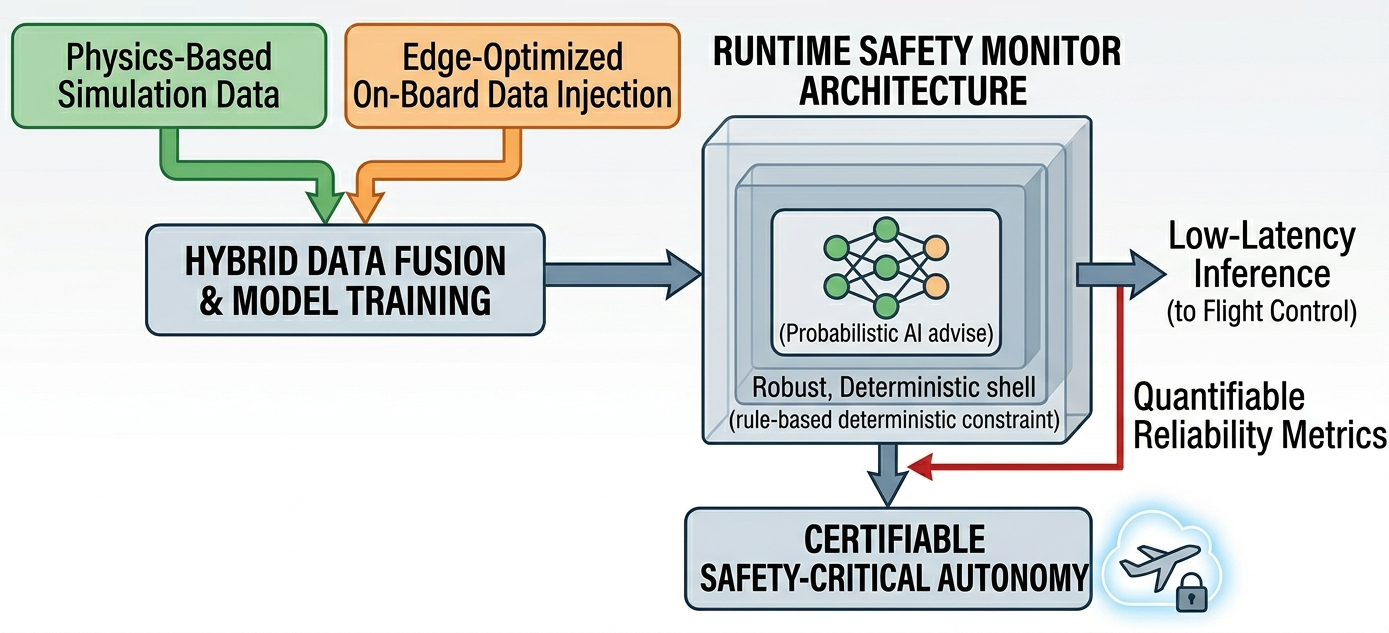
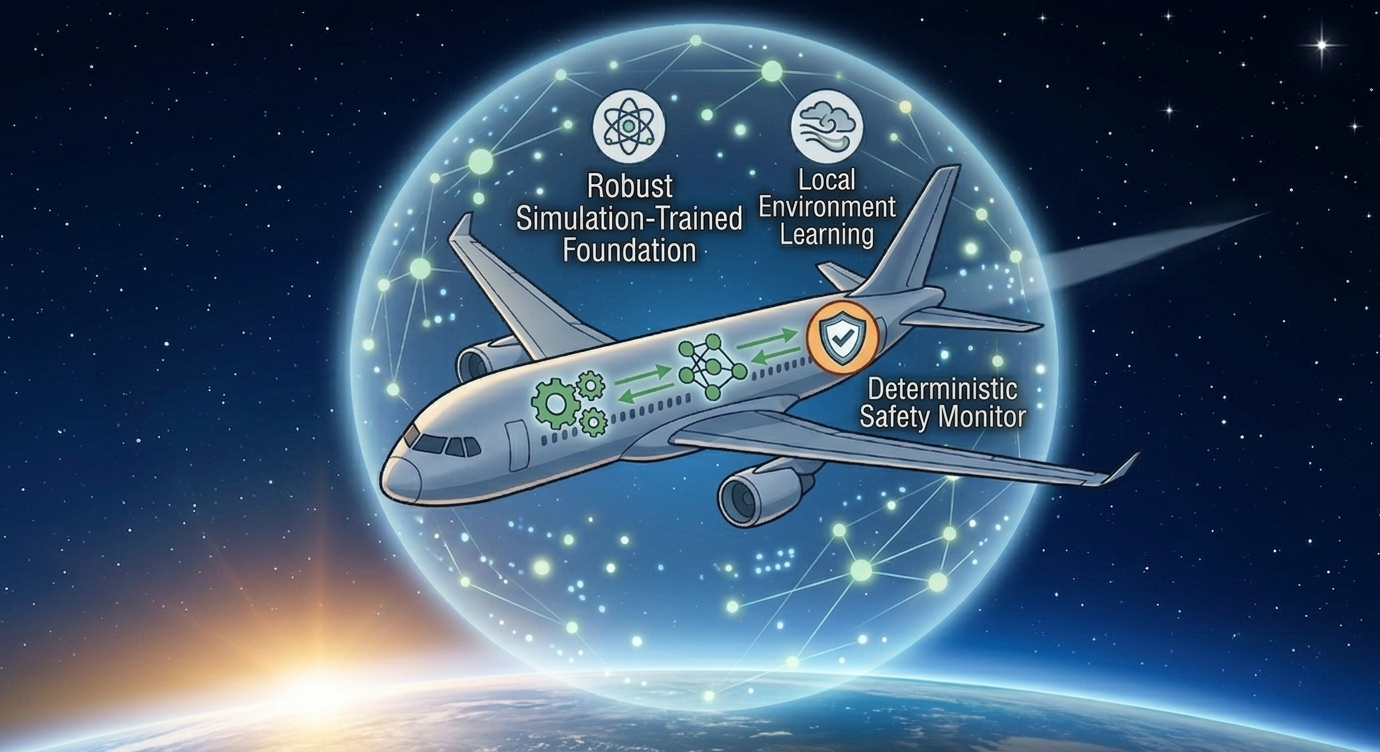
The path to reconciling the probabilistic nature of AI with these constraints lies in an "Architectural Wrapper" paradigm. Here, the AI acts as a high-performance advisory layer, continuously supervised and constrained by a separate, rule-based, and fully deterministic safety recovery logic.
A Two-Tier Validation Strategy: Simulation and Field Fusion
Bridging the data scarcity and "Reality Gap" problem requires two complementary approaches:
1. Physics-Based High-Fidelity Simulation
This approach uses model-based development tools compliant with the DO-331 standard [2]. Inside a high-fidelity virtual environment—a digital twin of the aircraft with its complete sensor and actuator physics—every conceivable "certification-credit" failure mode is automatically swept. The model learns the signatures of extreme and dangerous events without ever leaving the ground.
2. Edge-Optimized On-Board Data Injection
Traditional online learning is strictly prohibited in flight for certified software. The solution is an On-board Verification Engine that operates differently. It takes real-time sensor noise profiles and synthesizes novel, anomalous conditions directly on the aircraft's edge gateway. This process runs in a controlled "shadow-mode," where the model observes and learns but does not act on its new knowledge. The fine-tuned parameters are only deployed as part of the next official, certified software update cycle, ensuring that sensitive raw data never leaves the aircraft and safety is never compromised.
Training Reliable Edge Computing Modules for Certification
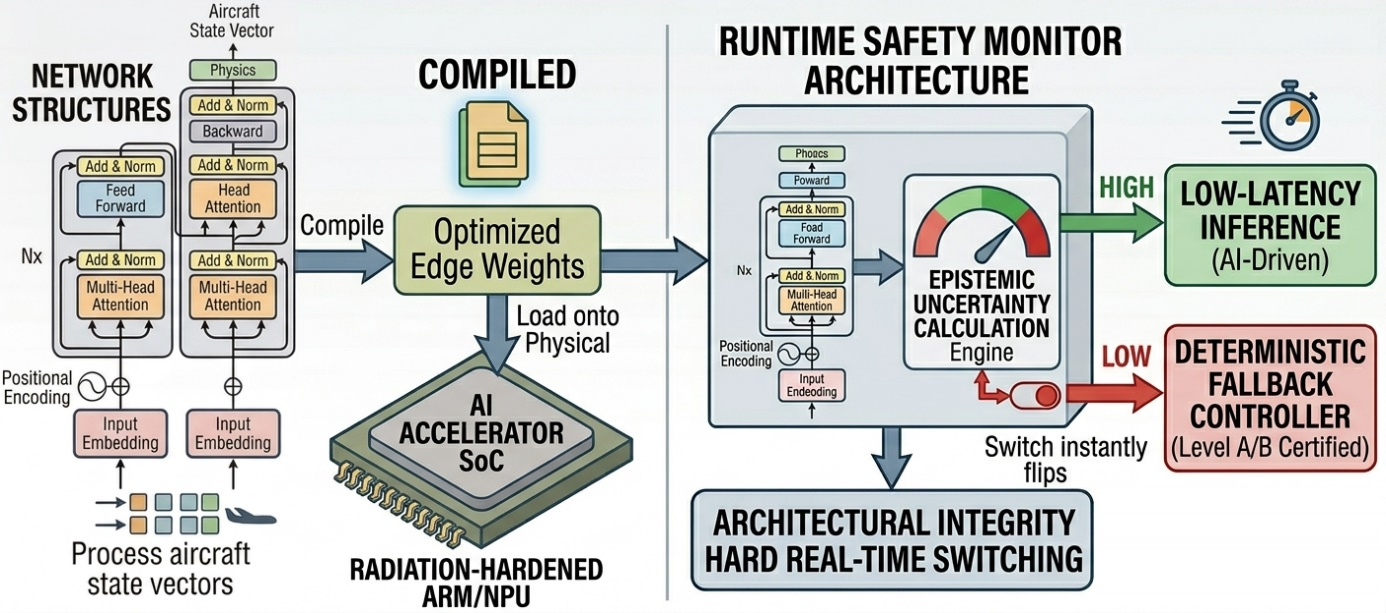
This hybrid strategy is evaluated using a Transformer-based model, optimized for time-series state estimation, and trained to run on radiation-hardened or high-reliability Edge AI hardware, such as dedicated AI accelerator ICs or SoCs.
The critical architectural innovation is the Runtime Safety Monitor. The model does more than just decide; it constantly reports its own Epistemic Uncertainty, or Inference Confidence. If this confidence score ever falls below a predefined, rigorously tested threshold, the AI is instantly bypassed. A deterministic fallback controller—Level A/B certified software—seamlessly takes over. This "Hybrid Integrity" model provides the best of both worlds: the AI delivers high performance, while the unyielding traditional logic provides the absolute safety guarantee.
Why This Hybrid Strategy Is an Imperative
Purely cloud-based approaches fail to meet physical timing constraints. Pure simulation fails to capture the unpredictable complexity of long-term sensor aging and hardware degradation. The hybrid strategy is powerful because it fuses three elements: the deterministic safety of physics-based simulation, the authenticity of real-world data profiles, and the sovereign speed of edge computation. All of this is achieved while operating within the strict SWaP-C (Size, Weight, Power, and Cost) constraints essential for modern airframes.
Conclusion: Toward the Sovereign Sky
The shift to Edge AI in avionics is not a hardware refresh; it is a fundamental paradigm shift in systems engineering. It describes a future where an aircraft's intelligence does not depend on a distant, unreachable cloud, but relies on its own robust simulation-trained foundation and the capacity to learn from its local environment under the unwavering supervision of deterministic safety monitors. The principle is clear: true safety in the real world demands turning away from the cloud and looking beyond the threshold, to the edge.
References
- [1] RTCA, Inc., "Software Considerations in Airborne Systems and Equipment Certification", RTCA DO-178C, 2011.
- [2] RTCA, Inc., "Model-Based Development and Verification Supplement to DO-178C", RTCA DO-331, 2011.
- [3] European Union Aviation Safety Agency (EASA), "EASA Concept Paper: EASA AI Roadmap 2.0", 2023.
- [4] Federal Aviation Administration (FAA), "Roadmap for Artificial Intelligence Safety Assurance", Washington, DC, USA: FAA, 2024.