

Imagine an AI-powered surgical robot mid-procedure. Its vision system detects a critical vessel in real time and must immediately halt the cutting tool. The model inference is correct. The decision is right. But the response arrives 3 milliseconds late.
That 3 milliseconds is not a benchmark footnote. It is a clinical failure.
This scenario sits at the heart of a question the medical AI community cannot avoid much longer: what hardware should run AI inference in safety-critical medical devices? The instinctive answer, a modern GPU, turns out to be the wrong one for a surprisingly deep set of reasons.
The Promise and the Problem
Over the last decade, deep learning has demonstrated genuine clinical value. Models now match or exceed specialist-level performance in detecting diabetic retinopathy, classifying skin lesions , flagging pulmonary nodules on CT, and predicting sepsis onset from ICU time-series data. The accuracy numbers are compelling.
But accuracy is a statistical property measured over a dataset. A deployed medical device operates on a single patient, in real time, under physical and regulatory constraints that a benchmark leaderboard never captures. When we move from “the model is accurate” to “the device is safe,” the hardware substrate suddenly matters enormously.
Three constraints define the gap: determinism, latency, and certification.
The Non-Determinism Problem
Modern GPUs are throughput-optimized processors. Their scheduling, memory access patterns, thermal throttling behavior, and driver-level concurrency are designed to maximize aggregate throughput across thousands of parallel threads. This is exactly what makes them excellent for training large models. It is also exactly what makes them problematic for hard real-time systems.
In a GPU-based inference pipeline, the same input can produce varying latencies depending on thermal state, memory bus contention, background driver tasks, and OS scheduling. This variance is called as jitter, and this may be invisible in a cloud serving application where a few extra milliseconds average out across millions of requests. In a real-time closed-loop medical system, jitter breaks the timing guarantees on which safe operation depends.
An infusion pump controller, a ventilator’s neural-network-driven breath detection module, or a radiation therapy beam gating system cannot operate on “usually fast enough.” They require bounded, predictable, worst-case execution time, a property called determinism.
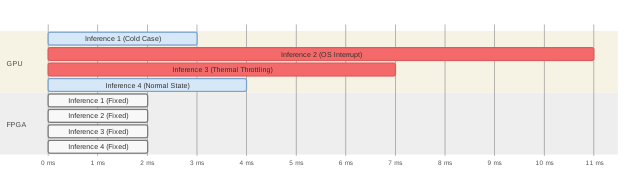
FPGAs, by their nature, provide exactly this: every clock cycle is accounted for, every data path is fixed in silicon at synthesis time, and there is no operating system, no driver stack, and no background process competing for resources.
Why GPUs Fall Short in Embedded Medical Devices
Beyond determinism, GPUs face practical deployment barriers in medical hardware:
- Power and thermal envelope: Clinical devices such as bedside monitors, handheld ultrasounds, implantable adjacent processors operate under strict power budgets. A GPU capable of running a meaningful neural network draws tens to hundreds of watts. Modern FPGAs targeting inference workloads operate in the 5–25W range while delivering sub-millisecond latency.
- Form factor: Many medical devices are physically constrained. An FPGA integrates the entire inference pipeline, including preprocessing, model execution, and output arbitration into a single chip. There is no PCIe slot, no cooling fan, and no motherboard.
- Supply chain and longevity: Medical devices have regulatory lifespans of 10-15 years. GPU generations turn over in 18-24 months. An FPGA design, once certified, can be locked and maintained across the device’s entire lifecycle without hardware redesign.
- Soft error sensitivity: In high-radiation environments (radiotherapy suites, nuclear medicine), CMOS logic in GPUs is more vulnerable to single-event upsets than radiation-hardened FPGA variants. For some applications, this is not a theoretical concern, it is a patient safety issue.
What FPGAs Actually Provide
An FPGA is a reconfigurable logic fabric, essentially, a chip whose internal wiring can be defined in hardware description language (VHDL or Verilog) and burned into the device. For AI inference, this translates to a custom dataflow architecture where the neural network’s computation graph is physically instantiated as a circuit.
The practical consequences are significant. There is no memory hierarchy stall from cache misses because data flows through pipeline stages in a fixed schedule. There is no OS interrupt that can preempt inference mid-execution. Worst-case latency is not a statistical estimate, it is a provable upper bound derived from the clock frequency and pipeline depth.
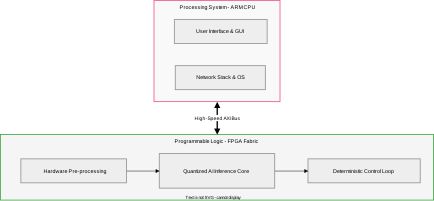
Tools like AMD/Xilinx Vitis AI and Intel OpenVINO now provide quantization-aware training flows that compile neural networks directly to FPGA bitstreams, significantly lowering the barrier for AI teams without hardware design backgrounds. Platforms like the Zynq UltraScale+ further integrate ARM cores alongside the FPGA fabric, enabling a clean split: the CPU handles high-level device management while the FPGA fabric handles deterministic inference.
IEC 62304: When Certification Becomes a Design Constraint
IEC 62304 is the international standard governing medical device software lifecycle processes. Compliance is mandatory for CE marking in Europe and strongly expected in FDA 510(k) and PMA submissions in the United States. The standard classifies software by the severity of harm its failure could cause: Class A (no injury), Class B (non-serious injury), and Class C (serious injury or death).
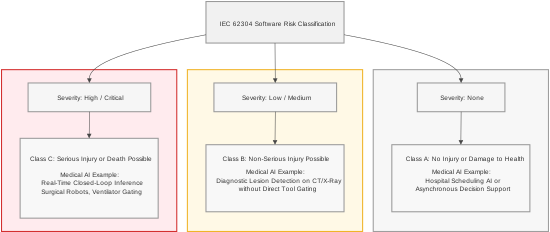
For Class C software, which covers most real-time inference components in active medical devices, IEC 62304 demands rigorous traceability from requirements through architecture, implementation, verification, and maintenance. Crucially, it requires that software units have testable, bounded behavior.
This creates a certification problem for GPU-based AI pipelines. How do you formally verify the worst-case execution time of a CUDA kernel running on a proprietary driver stack? How do you demonstrate that a thermal throttling event cannot produce a response delay that exceeds a safety-critical deadline? These questions do not have clean answers for GPUs.
For FPGAs, the answers are structural. A synthesized netlist has a provable critical path. Timing analysis tools produce verified setup and hold margins at every register. The absence of a runtime environment eliminates entire categories of non-deterministic behavior that would otherwise require exhaustive testing to bound. This does not make FPGA-based medical AI trivially certifiable, but it makes the certification argument tractable in a way that GPU-based pipelines often cannot match.
The Takeaway
The question is not whether AI belongs in medical devices. It clearly does, and the clinical evidence is accumulating rapidly. The question is whether we are building these systems on a foundation that can actually support the guarantees medicine requires.
Accuracy is necessary. It is not sufficient.
A model that is 99% accurate but non-deterministically late fails differently from a model that is 97% accurate and provably bounded, and in a clinical context, the latter failure mode is far more manageable. When hardware choice directly affects whether a timing guarantee can be made, verified, and certified, that choice becomes a patient safety decision.
The millisecond is not a performance metric. It is a design constraint.
Conclusion
FPGA is not a nostalgic choice or a niche workaround, it is increasingly the architecturally correct answer for a specific and growing class of problems: AI inference at the edge of a medical device, where latency must be bounded, behavior must be certifiable, and failure has consequences that extend beyond a degraded user experience.
This does not mean every medical AI system should run on an FPGA. Cloud-connected diagnostic pipelines, population-level screening tools, and clinical decision support systems that operate asynchronously from the patient have different constraints, and GPUs or CPUs may serve them well. The point is that the hardware decision should follow from the requirements of timing guarantees, safety classification, power envelope and regulatory pathway, rather than from familiarity or convenience.
As the field matures and more AI-powered devices move toward regulatory submission, the ability to make and defend hardware architecture decisions will become a core competency for medical AI teams. Understanding why determinism matters, what IEC 62304 demands from a software and hardware stack, and where FPGA fits in that picture is no longer a hardware engineer’s concern alone. It is part of building systems that can actually be deployed, certified, and trusted in a clinical environment.
The accuracy of the model gets it into the device. The architecture of the hardware gets the device to the patient.
References
- [1] V. Gulshan et al., “Development and Validation of a Deep Learning Algorithm for Detection of Diabetic Retinopathy in Retinal Fundus Photographs,” JAMA, vol. 316, no. 22, pp. 2402–2410, Dec. 2016. doi: 10.1001/jama.2016.17216
- [2] A. Esteva et al., “Dermatologist-level classification of skin cancer with deep neural networks,” Nature, vol. 542, no. 7639, pp. 115–118, Feb. 2017. doi: 10.1038/nature21056
- [3] D. Ardila et al., “End-to-end lung cancer screening with three-dimensional deep learning on low-dose chest computed tomography,” Nat. Med., vol. 25, no. 6, pp. 954–961, Jun. 2019. doi: 10.1038/s41591-019-0447-x
- [4] M. A. Reyna et al., “Early Prediction of Sepsis From Clinical Data: The PhysioNet/Computing in Cardiology Challenge 2019,” Crit. Care Med., vol. 48, no. 2, pp. 210–217, Feb. 2020. doi: 10.1097/CCM.0000000000004145
- [5] T. Amert, N. Otterness, M. Yang, J. H. Anderson, and F. D. Smith, “GPU Scheduling on the NVIDIA TX2: Hidden Details Revealed,” in Proc. IEEE Real-Time Systems Symposium (RTSS), Paris, France, Dec. 2017, pp. 104–115.
- [6] Y. Umuroglu et al., “FINN: A Framework for Fast, Scalable Binarized Neural Network Inference,” in Proc. ACM/SIGDA Int. Symp. Field-Programmable Gate Arrays (FPGA ‘17), Monterey, CA, USA, Feb. 2017, pp. 65–74. doi: 10.1145/3020078.3021744
- [7] IEC 62304:2006/AMD 1:2015, Medical Device Software – Software Life Cycle Processes, International Electrotechnical Commission, Geneva, Switzerland, 2015.