

Eye tracking has always had an expensive problem. The systems that can reliably tell whether your eyes are open, closed, or looking left or right have traditionally relied on infrared sensors and head-mounted rigs — hardware that costs thousands of dollars and puts the technology out of reach for most hospitals, classrooms, and home users. A new study out of Gazi University in Turkey set out to test a simple but bold question: what if a plain, off-the-shelf webcam was enough, as long as the software behind it was good enough?
The answer, according to the researchers, is a resounding yes. Using nothing more exotic than a Logitech C922 Pro webcam and a modest laptop with an entry-level graphics card, they trained deep learning models that classified eye states with up to 99.81% accuracy — a number that rivals what specialized, high-cost eye trackers can achieve.
- 99.81%: Peak accuracy (ResNet & Custom CNN)
- 3,206: Images across 50 participants
- 93.5%: Accuracy even at heavily pixelated resolution
- $60: Approx. cost of the webcam used
Why eye blinks matter more than you'd think
Blinking isn't just a reflex that keeps your eyes moist. It's a surprisingly rich signal. Doctors use blink patterns to flag digital eye strain in people who stare at screens all day. Safety engineers use it to catch drowsy drivers before they nod off at the wheel. And for people living with severe motor impairments — conditions like ALS, for instance — blinking and eye movement can become one of the only remaining channels for communicating with the outside world, powering everything from spelling boards to wheelchair controls.
The catch has always been hardware. Infrared trackers and head-mounted cameras deliver great precision, but they're costly, fiddly to calibrate, and impractical to hand out at scale. Webcams are cheap and everywhere, but historically the software running on top of them hasn't been accurate enough to trust for anything serious.
What the researchers actually built
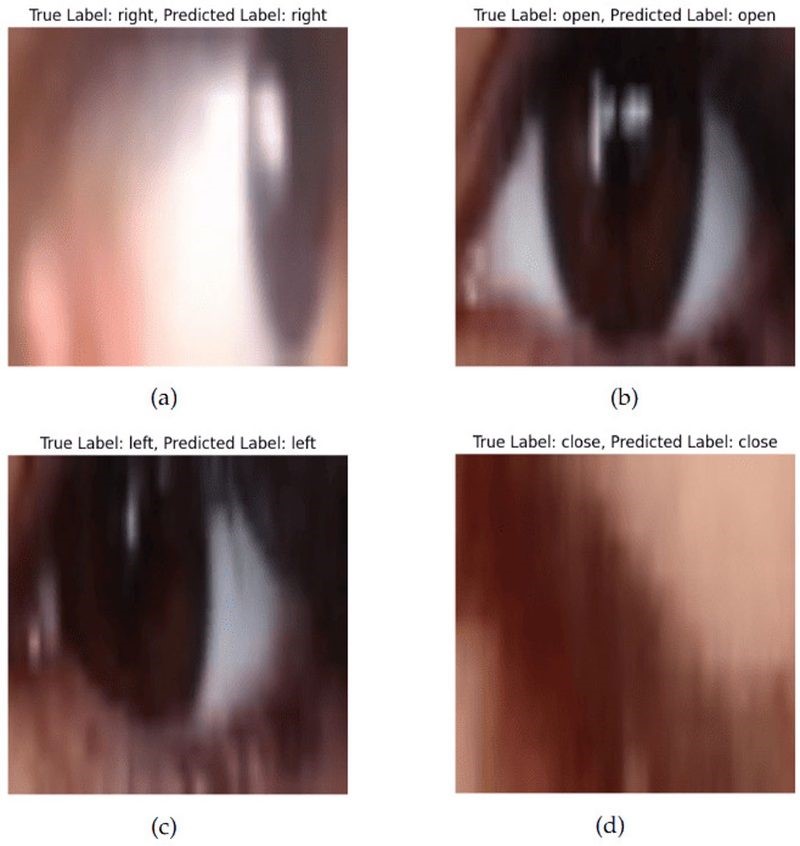
The team framed the problem as a straightforward four-way classification task: for any given frame, is the eye Open, Closed, looking Left, or looking Right? To teach a computer to answer that reliably, they needed a large, varied set of labeled eye images — so they combined three public datasets from Kaggle with footage they recorded themselves from 50 volunteers (28 men, 22 women, ages 18 to 45).
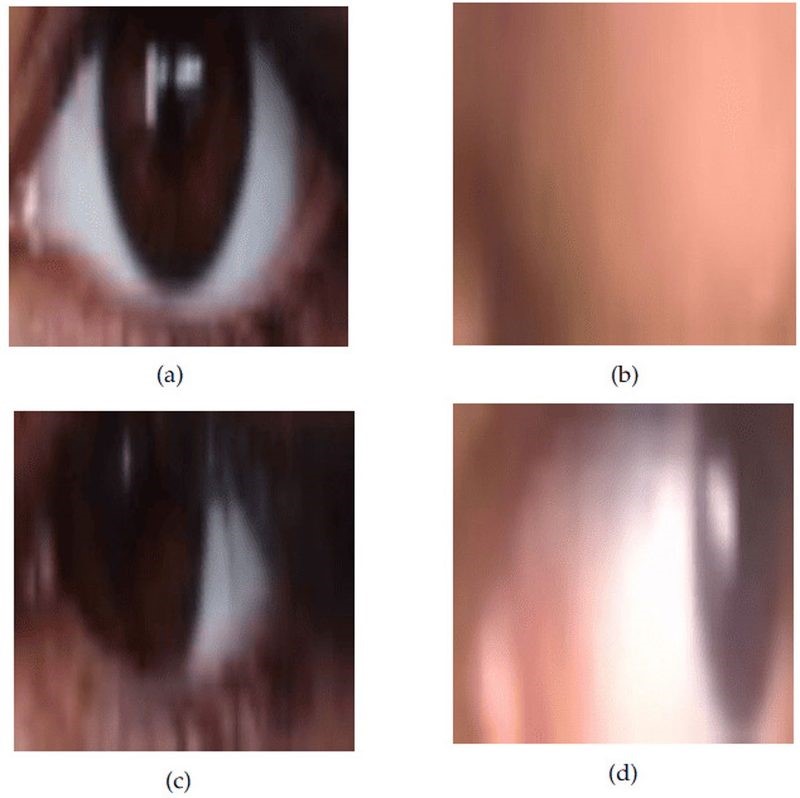
To make sure the models wouldn't just work well in ideal conditions, the researchers deliberately stress-tested their data collection. Fifteen participants wore prescription glasses and five wore sunglasses, to see how the models coped with reflections and occlusion. Footage was shot in both well-lit rooms and dim, low-light settings. Every frame was hand-labeled using an annotation tool, then independently double-checked by a second researcher to weed out ambiguous or mislabeled frames.
The final dataset skewed heavily toward "eyes open," which makes sense — people blink far less often than they keep their eyes open, and glance left or right even less. Out of 3,206 total images, 1,504 were "Open," 698 were "Closed," and the two directional classes made up the rest.
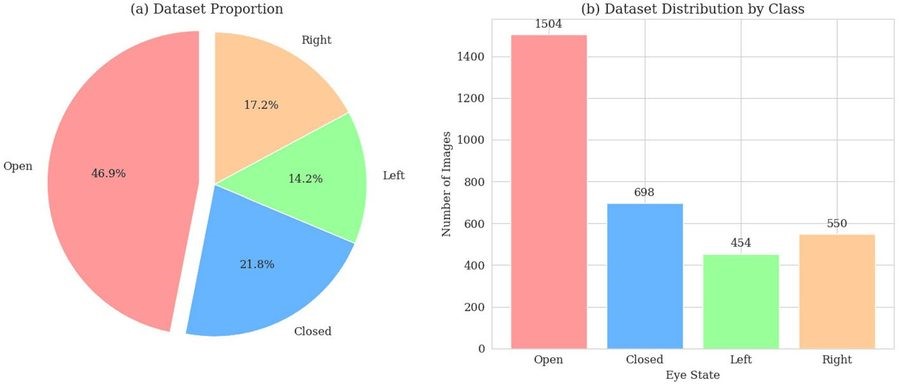
To stop the models from simply learning to guess "Open" every time, the team leaned hard on data augmentation during training — randomly flipping images horizontally, nudging brightness up or down by 30% to simulate different lighting, applying small random crops, and even injecting artificial sensor noise to mimic the imperfections of a cheap webcam.
Three architectures, one showdown
Rather than betting on a single model, the researchers pitted three different neural network designs against each other:
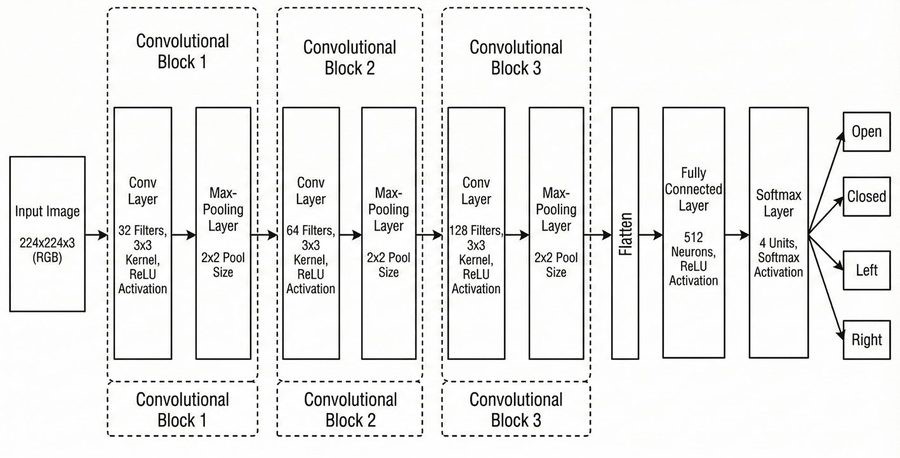
1. A custom, lightweight CNN built from scratch
This was purpose-built for the task: three simple convolutional blocks (32, then 64, then 128 filters), each followed by pooling, feeding into a fully connected layer and a final four-way softmax output. Nothing fancy — just a compact network designed to be fast.
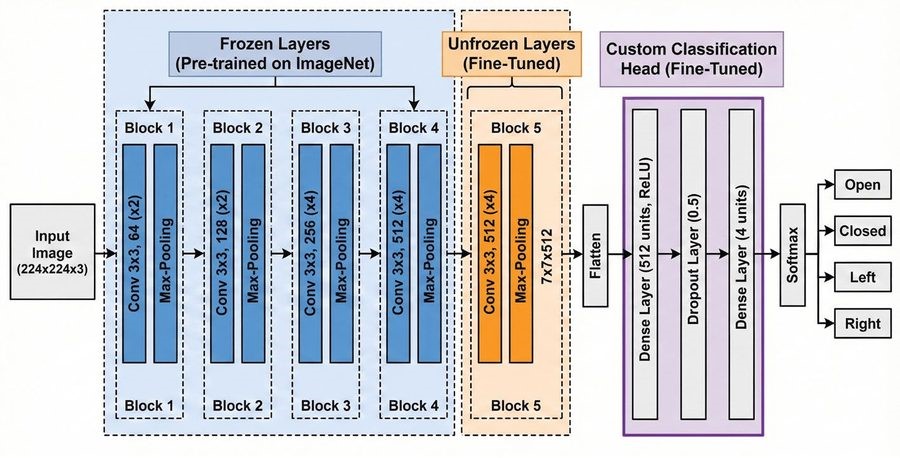
2. VGG-19, fine-tuned
VGG-19 is a well-known, 19-layer deep network that's normally used as a fixed, off-the-shelf feature extractor. On its own, that approach performed poorly here — under 60% accuracy. The breakthrough came when the researchers unfroze the deepest convolutional block (Block 5) and let it retrain on the eye dataset, then swapped in a custom classification head. That single change pushed accuracy from below 60% all the way up to 99.66%.
3. ResNet101v2
A 101-layer residual network, chosen specifically because its "skip connections" let gradients flow cleanly through very deep layers during training, avoiding the vanishing-gradient problem that can cripple deep networks. It was initialized with ImageNet weights and given a new four-unit output layer for this task.
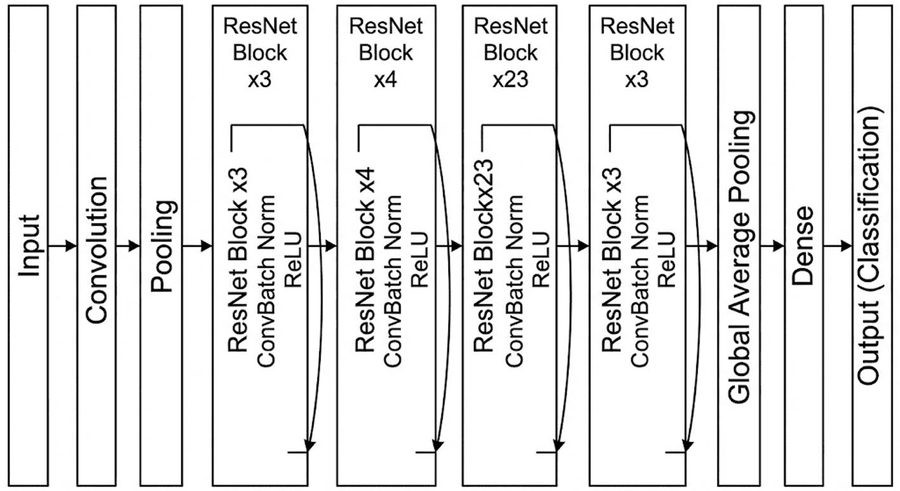
To keep the comparison honest, every model was evaluated with a strict subject-independent 10-fold cross-validation. In plain terms: the dataset was split by person, not by individual frame, so a model was never tested on a face it had already seen during training. That matters a lot — it's the difference between a model that's truly learned to read eye states versus one that's just memorized a particular person's face.
The results: deep isn't always better
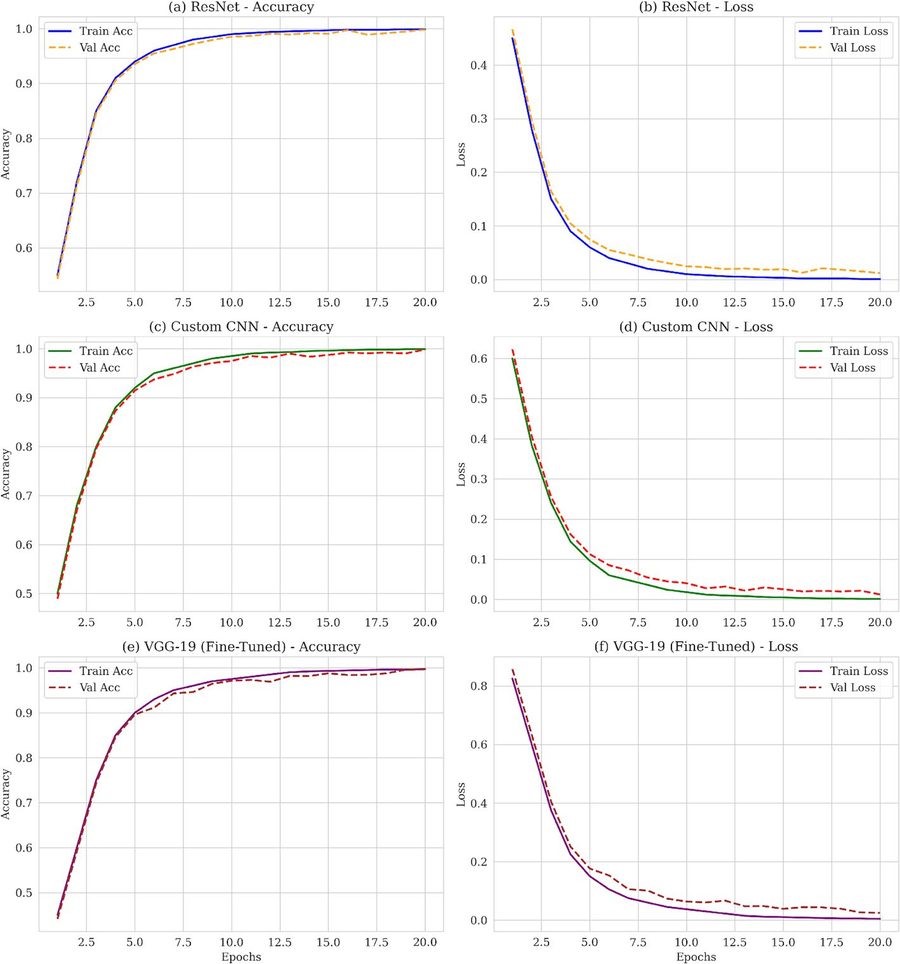
All three models performed remarkably well, but the standout finding was this: the lightweight custom CNN matched the massive ResNet101v2 stride for stride.
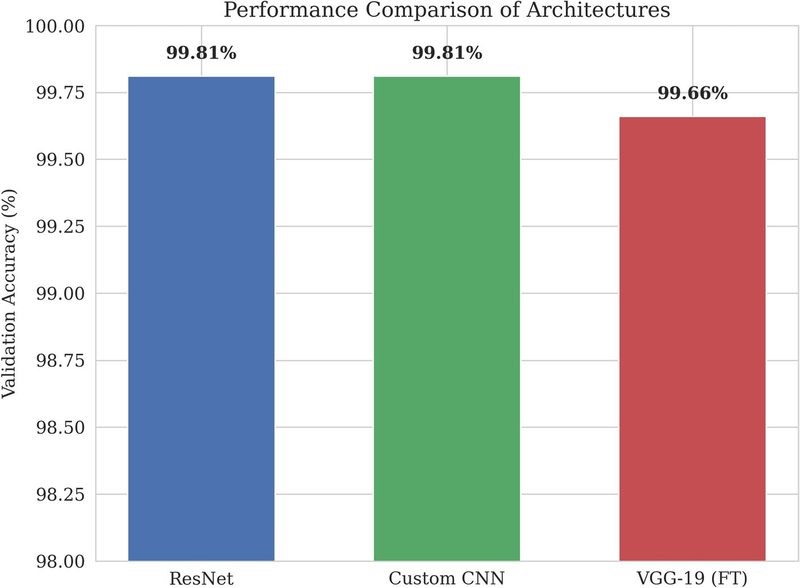
| Model | Accuracy | Parameters | GPU inference speed |
|---|---|---|---|
| ResNet101v2 | 99.81% | ~42.6 million | ~45 FPS |
| Custom CNN | 99.81% | ~2.1 million | 300+ FPS |
| VGG-19 (fine-tuned) | 99.66% | ~143.6 million | ~28 FPS |
The custom CNN used roughly 20 times fewer parameters than ResNet101v2 and 68 times fewer than VGG-19 — yet matched or beat both of them on accuracy.
That efficiency gap matters more than it might first appear. VGG-19's inference speed of about 28 frames per second falls just short of the 30 FPS a standard webcam captures, which risks dropped frames or lag in a live system. The custom CNN, by contrast, ran at over 300 FPS — giving it huge headroom to run in the background of a driver-monitoring dashboard or an assistive-communication app without slowing anything else down.
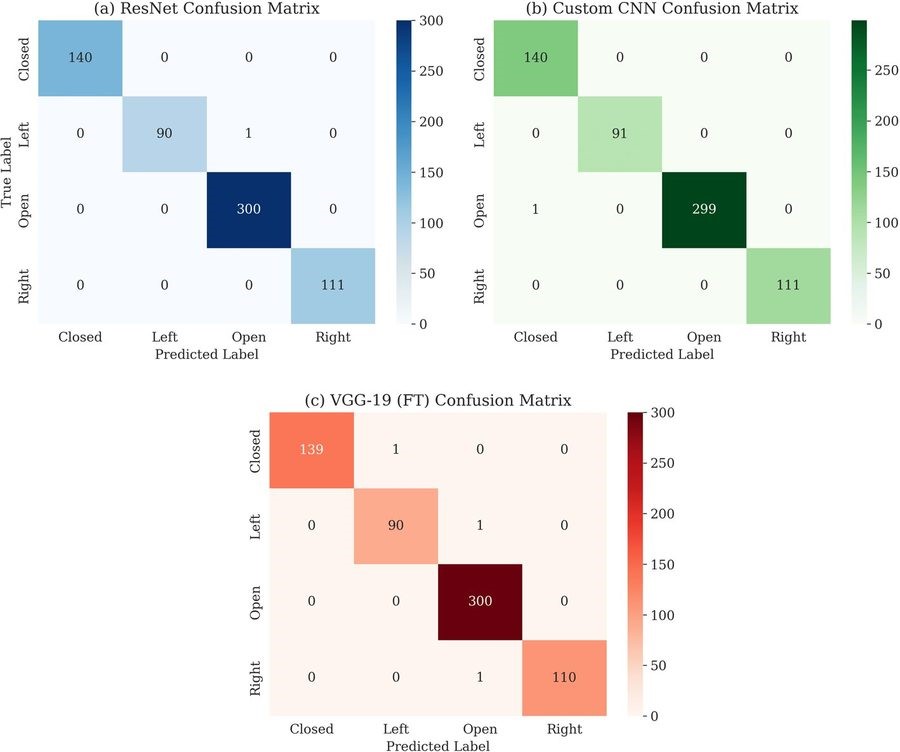
Digging into class-by-class performance, both ResNet and the custom CNN hit a perfect 1.00 F1-score for detecting "Open" and "Closed" eyes — meaning essentially zero missed blinks, which is exactly what you'd want in a drowsy-driver alert system. The directional "Left" and "Right" classes came in just a hair behind, at 0.99, likely because those categories had fewer training examples to begin with.
Stress-testing on ugly, low-quality footage
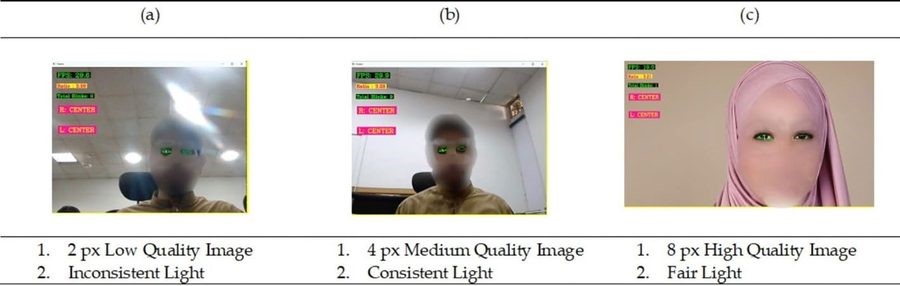
Real-world webcams don't always deliver clean, crisp video — bandwidth drops, compression kicks in, and resolution can degrade badly. So the researchers deliberately sabotaged their own test images, down-sampling them to just 25% and 50% of their original resolution to simulate a poor connection or a cheap sensor.
| Image quality | Resolution | Accuracy |
|---|---|---|
| Low (25% scale) | 56 × 56 px | 93.50% |
| Medium (50% scale) | 112 × 112 px | 97.20% |
| High (100% scale) | 224 × 224 px | 98.80% |
Even at the harshest degradation level — images so blocky they'd be barely recognizable to a human at a glance — the system still classified eye states correctly 93.5% of the time. That kind of resilience suggests the models learned genuine, structural features of the eye rather than memorizing pixel-level noise from the training set, which is a strong sign against overfitting.
Where it still falls short
The paper is refreshingly upfront about its limits, and they're worth knowing before getting too excited:
- It's a snapshot classifier, not a fatigue detector — yet: The models identify what the eye is doing in a single frame. Turning that into a genuine drowsy-driver alarm requires tracking blink patterns over time (using something like PERCLOS, the "percentage of eyelid closure over time" metric), which this study didn't build.
- 50 participants is a modest sample: The authors call their own dataset an "initial proof-of-concept" rather than a fully representative one. It doesn't include children, elderly users, or people with specific eye conditions.
- 30 FPS webcams miss micro-blinks: Specialized 200 Hz clinical trackers can catch eye movements that happen in milliseconds; a standard webcam simply can't sample fast enough to capture that level of detail.
- Glare is the main failure mode: When the researchers dug into the rare misclassifications, they found the errors weren't random — they clustered around specific situations, mainly strong light reflecting off prescription glasses and obscuring the iris.
- No test yet on a totally separate, external dataset: The models have proven they generalize to unseen people within this study's own data collection, but haven't been validated against a completely independent benchmark dataset from another lab.
Quick reality check: The 99.81% figure is real, but it was measured under realistic-yet-controlled indoor conditions. The authors themselves describe it as an "upper-bound" result and call for larger, multi-center studies before this kind of system gets deployed in cars or clinics.
Why this matters beyond the lab
Set aside the specific accuracy numbers for a second, and the bigger story here is about access. If a $60 webcam paired with well-designed, efficient software can get within striking distance of dedicated eye-tracking hardware, that changes who can actually use this technology. A driver-fatigue system doesn't need a specialized sensor bolted to the dashboard. A communication aid for someone with limited mobility doesn't need a piece of medical equipment that costs as much as a used car.
The efficiency of the custom CNN is arguably the quieter, more important finding of the whole paper. At just 8 MB in size and capable of running on modest, years-old laptop hardware, it's small enough to sit comfortably on everyday devices — leaving plenty of computational room for whatever application is built on top of it, whether that's an alert system, a virtual keyboard, or a broader human-computer interaction tool.
The bottom line
This study doesn't claim to replace clinical-grade eye trackers outright — and it's careful not to overstate what a single-frame classifier can do on its own. But it makes a compelling case that the long-standing trade-off between "cheap" and "accurate" in eye tracking is narrower than most people assume. With the right preprocessing pipeline, careful data augmentation, and a thoughtfully designed lightweight model, a basic webcam can get remarkably close to hardware that costs orders of magnitude more — opening the door to driver-safety tools, assistive communication devices, and human-computer interaction systems that don't require anyone to buy specialized equipment first.
References
- Ata, F., Ayturan, K., Hardalaç, F., & Kutbay, U. (2026). "Optimized deep learning architectures for high precision eye blink detection on consumer grade hardware." Discover Artificial Intelligence, 6:537. Published under a Creative Commons Attribution 4.0 International License. Full paper: https://doi.org/10.1007/s44163-026-01446-2