

Imagine a person living with Parkinson’s disease and an implanted adaptive deep-brain stimulator. The device continuously measures a neural rhythm associated with the person’s motor state, estimates a feature such as beta-band power or phase, checks whether an intervention is allowed and schedules a stimulation pulse. If the estimate is late or the pulse arrives with uncontrolled timing variation, the system may stimulate a different neural state from the one it meant to target. In a phase-locked therapy, a few milliseconds are not merely an inconvenience; they are part of the control law.
That makes closed-loop neuromodulation different from most medical-AI applications. A radiology model can be clinically useful even if one inference takes slightly longer than the next. An implanted controller that senses and stimulates on the same timescale as an oscillation must preserve both correctness and timing. Accuracy remains necessary, but it is not sufficient. The useful output is a correct decision delivered before a known deadline.
A Million-to-One Front-End Problem
The first obstacle appears before any FPGA, CPU or neural network sees the data. In adaptive deep-brain stimulation, the recording path may need to resolve local field potentials around 1 μV while tolerating a differential stimulation artifact greater than 100 mVpp and a common-mode artifact above 1 V. Those figures imply a challenge approaching six orders of magnitude between the signal of interest and the device’s own electrical disturbance.
This is not solved by declaring a fixed digital blanking interval. Artifact management starts with electrode configuration, input range, common-mode rejection, charge-balanced stimulation, amplifier recovery and the analog filter chain. Some systems use blanking and accept a short interval of lost data. Others, including the AlphaDBS architecture described by Arlotti and colleagues, suppress the artifact in the sensing circuitry and do not use blanking. Digital interpolation or template removal can help in other designs, but only if the front end has avoided destructive saturation. No downstream accelerator can reconstruct information that never reached the converter.
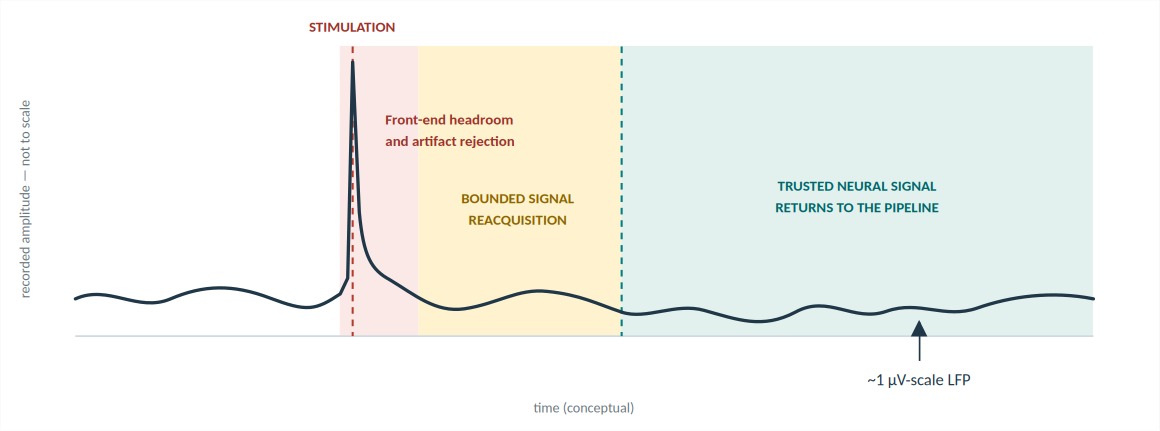
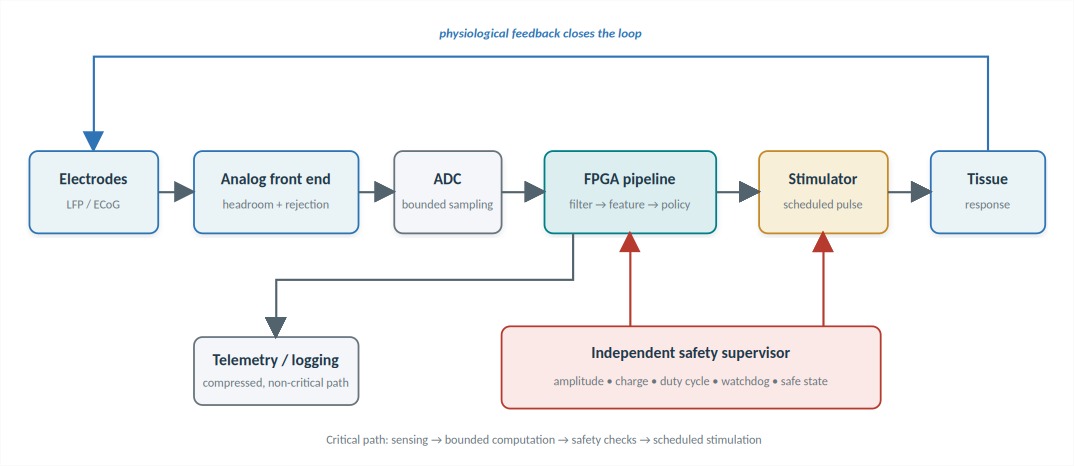
The phrase “decode latency” hides several deadlines. Samples must first arrive at a known cadence. Filters and feature estimators need a defined observation window. A decision policy must finish, safety rules must be evaluated and the stimulation command must cross its final interface. If wireless communication or a host operating system sits inside the critical path, its latency distribution becomes part of the therapy.
A 2024 evaluation of phase-triggered stimulation on the investigational CorTec Brain Interchange platform illustrates the point. The researchers used a phase-locked-loop strategy to compensate for an approximately 21 ms command-to-stimulation latency. Mean phase targeting was close to the configured goal, yet clinical trials showed wider timing variation and more missed targets than saline tests. The authors linked part of that gap to exceptions and environmental influences on the system’s communication path. The lesson is broader than any single device: average latency can look acceptable while tail behavior still changes control performance.
Determinism therefore has to be claimed end to end. A static FPGA pipeline can eliminate operating-system scheduling jitter inside the feature and decision stages, but that guarantee is meaningful only when the converter, clock-domain crossings, memories, buses and stimulation interface are also bounded. “Implemented in hardware” is not the same as “timing proven”.
Why the Question Is Becoming Urgent
Two recent developments raise the stakes. First, fully implantable bidirectional systems are moving through formal clinical and regulatory programs. In April 2026, CorTec announced FDA Breakthrough Device Designation for the Brain Interchange system in chronic stroke motor rehabilitation. The designation can facilitate interaction and review, it is not marketing authorization and does not guarantee approval. The system remains investigational. Even so the milestone signals that closed-loop platforms are advancing beyond isolated laboratory demonstrations.
Second, channel density is rising sharply. A 2025 Nature Electronics report described a 50-μm-thick flexible CMOS interface with 65536 electrodes. The chip can simultaneously sample a selectable subset of up to 1024 channels and is wirelessly powered, with bidirectional communication to an external relay. It is not an FPGA system and it does not record all 65536 sites at once. Its importance here is architectural: as sensing scales, selection, compression, feature extraction and event detection increasingly need to happen close to the electrodes. Raw-data streaming cannot be assumed to be free.
Where an FPGA Actually Fits
An FPGA is most valuable when a research team needs a pipeline that is both changeable and cycle-accountable. Fixed-point filters can run in parallel across channels. Band-power or phase estimators can be deeply pipelined. A quantized decoder can be mapped to dedicated multiply-accumulate structures. Safety interlocks can run independently of the learning model. Each stage can expose explicit latency, throughput, overflow behavior and resource usage.
A 2025 University of Washington master’s thesis by Rajeev Bhavin Botadra provides a useful proof of concept. It describes an integrated closed-loop experimental system in which neural decoding was quantized and accelerated on FPGA hardware, reporting substantial speedup over CPU- and GPU-based pipelines. A thesis is not clinical evidence and a laboratory accelerator is not automatically an implant. But the work demonstrates the engineering value of hardware/software co-design for neural decoding: the algorithm can be reshaped around a deadline instead of merely ported after it is trained.
Not Every Neural Signal Is the Same Workload
Discussions of “brain-computer interfaces” often mix three distinct workloads. Adaptive Parkinson’s therapy commonly senses deep-brain local field potentials and tracks features such as beta-band power or phase. Cortical communication interfaces may decode ECoG activity over many surface channels. Intracortical systems may detect spikes and use firing-rate features. Their sample rates, channel counts, signal amplitudes, algorithms and acceptable delays are not interchangeable.
This distinction matters for hardware selection. A modest LFP controller may fit comfortably on a low-power MCU or dedicated DSP. A research system exploring hundreds of channels, multiple filter banks and several quantized models may benefit more from FPGA parallelism. A mature, high-volume implant can justify an ASIC. The requirement should select the substrate; the presence of AI should not.
Designing for Drift Without Moving the Safety Boundary
Neural interfaces are not calibrated once and forgotten. Electrode impedance changes, tissue responses evolve, behavior alters signal statistics and a decoder trained on one session may degrade months later. The engineering answer is not unrestricted self-modification inside a safety-critical loop. It is controlled adaptability with a fixed envelope.
Many updates do not require partial reconfiguration at all. Filter coefficients, thresholds, lookup tables or quantized model weights can live in bounded parameter memory, with range checks, versioning, integrity protection and an atomic switchover. Partial reconfiguration becomes relevant when the architecture itself must change. For example, replacing a feature extractor while the independent safety shell remains fixed. In both cases, change-impact analysis, verification, validation and traceability still apply. Reconfigurability is a capability, not a regulatory shortcut.
Power Is a System Budget, Not a Chip Number
Power claims in implantable electronics are easy to oversimplify. The decoder core, analog front end, ADCs, telemetry radio, memory, clock tree, wireless-power receiver and stimulation output all consume energy. A low-power inference block does not make the complete implant low power and a laboratory FPGA board does not predict the thermal behavior of a sealed cranial package.
For that reason, FPGA power should be measured under the intended activity pattern, not quoted from a data sheet. Clock gating, fixed-point precision, channel activation, memory access and telemetry duty cycle can matter as much as model size. The most credible development path is often to prototype and instrument the pipeline on reconfigurable hardware, identify which functions must remain flexible and harden stable high-activity blocks into an ASIC or custom SoC when the product power budget demands it.
Regulatory Reality: Evidence, Not Architecture Labels
FDA guidance for implanted BCI devices recommends describing the complete system, including acquisition, processing, stimulation, wireless functions, algorithms, power sources, safety features and the interactions among components. An update note now points sponsors to the agency’s 2023 device-software guidance and says implanted BCI devices should generally address an Enhanced Documentation Level, while the actual level remains device-specific. That replaces the older “Major Level of Concern” terminology.
For a deterministic controller, useful evidence can include timing budgets, static timing results, worst-case memory and bus analysis, clock-domain verification, fault-injection tests, safe-state behavior, hardware/software interface tests and traceability from hazards to mitigations. FPGA implementation can make some of this evidence easier to create because timing and parallel structure are explicit. It does not make the design correct by construction and it does not remove the need to validate the therapy as a clinical system.
What Deterministic Hardware Does Not Solve
A well-timed digital pipeline cannot compensate for a saturated amplifier, a poor electrode–tissue interface, unsafe stimulation parameters, an invalid biomarker or a decoder that fails under real-world behavior. It also does not solve packaging, long-term biocompatibility, cybersecurity, privacy, wireless coexistence or heat transfer. Closed-loop neurotechnology is a systems discipline precisely because failures cross boundaries: an RF delay can become a timing error, a model update can become a risk-control change and an artifact can masquerade as a neural feature.
The right claim for an FPGA is therefore narrower and stronger than “FPGAs are the only practical option.” Reconfigurable logic is a powerful place to prototype, measure and enforce a bounded digital control path. It is especially attractive when algorithms are still evolving but timing cannot be left probabilistic. Whether it remains in the final implant depends on channel count, update needs, power, package constraints, cost and the evidence strategy for the complete device.
Conclusion
The defining engineering problem in closed-loop neural interfaces is not simply that the neural signal is small or that the model is complex. It is that a tiny signal must remain trustworthy next to a much larger self-generated artifact, then travel through sensing, estimation, decision, safety and actuation before the relevant neural state has changed. That turns latency variation into a control variable.
FPGAs do not solve the entire problem, but they make one crucial part of it inspectable. They let engineers express the digital loop as a parallel circuit, quantify its worst-case timing, separate the therapy path from non-critical software and preserve enough flexibility to test new biomarkers and decoders. In research systems, that combination can shorten the distance between an algorithm and a defensible real-time implementation. In a product, the same architecture may remain in reconfigurable fabric or migrate to an ASIC.
The durable design principle is substrate-independent: protect the microvolt, budget the millisecond and prove the boundary between them. For a device operating under the skull, “fast on average” is not the promise that clinicians or patients need. The promise is that the right action arrives within a known window, and that the system remains safe when it cannot.
References
- M. Arlotti et al., “A New Implantable Closed-Loop Clinical Neural Interface: First Application in Parkinson’s Disease,” Front. Neurosci., vol. 15, p. 763235, 2021.
- H. Cho et al., “Development and Evaluation of a Real-Time Phase-Triggered Stimulation Algorithm for the CorTec Brain Interchange,” IEEE Trans. Neural Syst. Rehabil. Eng. Publ. IEEE Eng. Med. Biol. Soc., vol. 32, pp. 3625–3635, 2024.
- C. Remke, “CorTec Receives FDA Breakthrough Device Designation for Its Brain Interchange System in Stroke Rehabilitation — the First BCI Worldwide Designated for Stroke Motor Rehabilitation,” CorTec | Thinking ahead – Innovation in Neurotechnology.
- T. Jung et al., “A wireless subdural-contained brain–computer interface with 65,536 electrodes and 1,024 channels,” Nat. Electron., vol. 8, no. 12, pp. 1272–1288, Dec. 2025.
- R. B. Botadra, “Hardware Accelerated Brain-Computer Interfaces for Real-Time Neural Decoding,” M.S., 2025.
- Center for Devices and Radiological Health, “Implanted Brain-Computer Interface (BCI) Devices for Patients with Paralysis or Amputation - Non-clinical Testing and Clinical Considerations.” FDA.
- Center for Devices and Radiological Health, “Content of Premarket Submissions for Device Software Functions.” FDA.